Tag: Background Checks

  • Ninth Circuit Court of Appeals Strikes Down California Ammunition Background Check Law

    Ninth Circuit Court of Appeals Strikes Down California Ammunition Background Check Law

    In a landmark decision that’s sending shockwaves through the gun control community, the Ninth Circuit Court of Appeals has finally put an end to California’s burdensome ammunition background check system. After nearly eight years of legal battles, this ruling represents a significant victory for law-abiding gun owners who have long fought against unnecessary barriers to exercising their Second Amendment rights.

    Dramatic image of a courtroom gavel striking down a California law document with the Ninth Circuit seal visible

    California’s ammunition purchase requirements forced millions of responsible citizens to jump through hoops just to buy basic ammo for self-defense, sport shooting, and hunting. The process involved background checks at every transaction, creating delays, fees, and privacy concerns that did little to enhance public safety but plenty to infringe on constitutional freedoms.

    Years of Relentless Litigation Pay Off

    This wasn’t an overnight win. Gun rights organizations and individual plaintiffs endured multiple rounds of appeals, district court rulings, and bureaucratic resistance. The Ninth Circuit’s decision acknowledges what pro-2A advocates have argued all along: these restrictions fail to meet constitutional muster under modern Second Amendment scrutiny. Lawful purchasers shouldn’t be treated like criminals for simply stocking up on ammunition.

    The ruling opens the door for Californians to once again purchase ammo without the previous red tape. Retailers across the state can expect increased foot traffic as pent-up demand is finally released, and shooters can focus on training and preparedness rather than navigating a flawed government database.

    Well-stocked ammunition shelves in a California gun store with happy customers in the background

    What This Means for Gun Owners Statewide

    Expect ammunition prices to stabilize and availability to improve as the market responds to reduced regulatory friction. More importantly, this decision reinforces that the right to keep and bear arms includes the ability to acquire the necessary components without undue interference. Other states watching California’s experiment should take note—overreaching ammo control measures are vulnerable to legal challenge.

    Second Amendment supporters are celebrating this as further evidence that persistent advocacy and strategic litigation can roll back unconstitutional policies. The fight continues, but today’s Ninth Circuit ruling proves that the Constitution still protects the rights of the people.

    Join the Fight - Second Amendment Foundation

    References

  • New Federal Bill Introduced to Expand Gun Owner Privacy Protections in Digital Background Checks

    New Federal Bill Introduced to Expand Gun Owner Privacy Protections in Digital Background Checks

    In a bold step toward safeguarding the rights of law-abiding gun owners, a bipartisan group of senators has unveiled legislation that could reshape how firearm background checks handle sensitive personal data. The proposed bill targets the growing web of federal databases that have increasingly pulled purchaser information into shared systems, often without clear consent or oversight. By limiting broad data sharing, the measure aims to prevent unnecessary government surveillance while keeping the core background check process intact for public safety.

    Gun owners across the country have voiced frustration over how digital tools have expanded tracking capabilities in recent years. This new proposal directly addresses those worries by requiring stricter firewalls around individual records. Instead of allowing seamless integration across multiple agencies, the legislation would mandate that data from Form 4473 stays siloed unless specific, narrow conditions are met. Advocates argue this restores a crucial layer of privacy that the Founders intended when they enshrined the Second Amendment.

    Senators presenting legislation to protect gun owner data from federal databases

    Critics of unchecked digital expansion point to real-world examples where routine purchases have landed in expansive federal systems, raising fears of future misuse. The bill counters this by adding explicit prohibitions on using purchaser information for anything beyond the immediate check. Supporters highlight how this protects against potential political weaponization, especially as more states and agencies experiment with advanced analytics on firearm transactions.

    Pro-Second Amendment voices are already rallying behind the effort, noting that true freedom includes the right to keep personal decisions about self-defense private. The legislation also includes provisions for greater transparency, requiring annual reports on how any shared data is actually used. This built-in accountability could set a new standard for balancing security needs with constitutional protections.

    Industry experts predict the bill could gain traction quickly in the current climate of heightened awareness around digital privacy. With rising concerns over data breaches and government overreach, measures like this remind everyone that the right to bear arms shouldn’t come with a side of constant monitoring. Lawmakers behind the proposal emphasize that strong privacy safeguards actually strengthen compliance, as more citizens feel confident participating in legal channels.

    Responsible gun owner reviewing secure background check process on computer

    As the debate moves forward, gun enthusiasts are encouraged to reach out to their representatives and voice support for these vital protections. Preserving the sanctity of private firearm ownership remains essential to maintaining a free society. This legislation represents a timely pushback against the slow creep of surveillance, ensuring that future generations can exercise their rights without fear of unwarranted digital footprints.

    Join the Fight - Second Amendment Foundation

    References

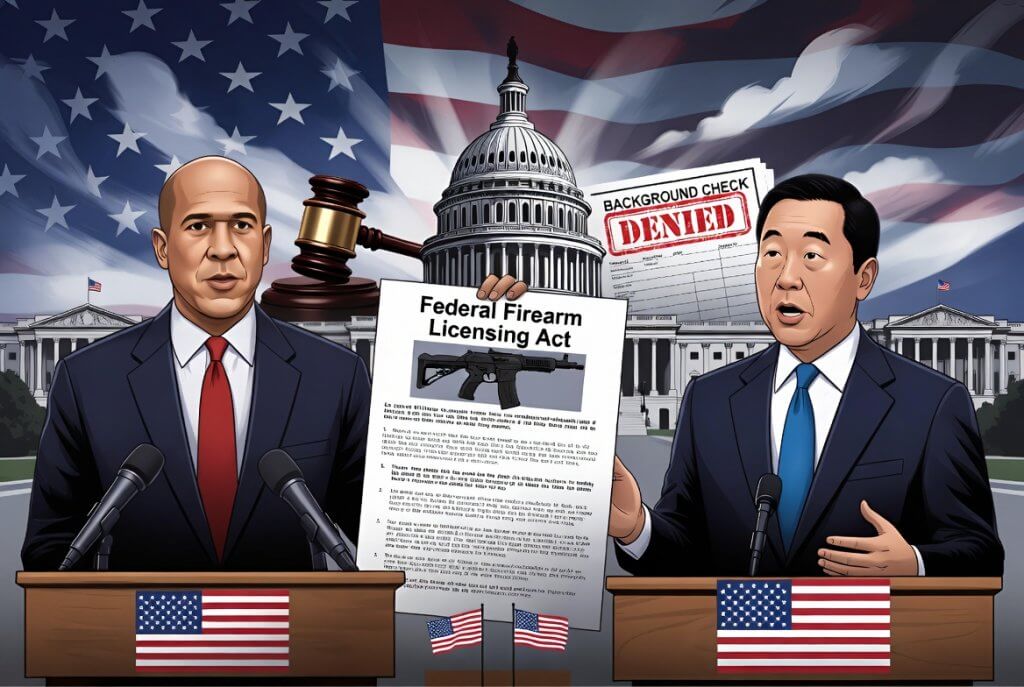
  • Senators Booker and Kim Reintroduce Federal Firearm Licensing Act Mandating Training and Renewals

    Senators Booker and Kim Reintroduce Federal Firearm Licensing Act Mandating Training and Renewals

    The latest push from New Jersey’s Democratic senators represents yet another blatant attempt to chip away at the Second Amendment under the guise of “public safety.” By reintroducing the Federal Firearm Licensing Act, they’re proposing a nationwide permission slip system that would force every law-abiding American to jump through federal hoops just to exercise a constitutional right. This isn’t about stopping criminals—it’s about creating a registry and control mechanism that burdens responsible gun owners while doing little to address actual violence.

    What’s Really in This Bill

    The legislation would require a federal license for any firearm purchase, complete with mandatory safety training that mixes written tests and live-fire components. Applicants would face expanded FBI background checks, and the license would need renewal every five years. Provisions allow for revocation if authorities decide someone “poses a risk,” a vague standard ripe for abuse. Proponents point to state examples, but those programs have consistently failed to deliver measurable drops in crime while driving up costs and wait times for honest citizens.

    Why This Approach Misses the Mark

    Real-world evidence shows that licensing schemes don’t disarm gang members or career criminals who already ignore laws. Instead, they create barriers for first-time buyers, single mothers in high-crime areas, and rural residents who rely on firearms for protection and hunting. Training mandates sound reasonable on paper, yet they ignore the millions of Americans who already pursue voluntary education through the NRA, USCCA, and local ranges—often at their own expense and initiative. Federalizing this process adds layers of bureaucracy without improving outcomes.

    History teaches us that gun control focused on owners rather than offenders simply shifts the burden onto the compliant. States with strict licensing haven’t outperformed constitutional carry states in violent crime reduction when you account for demographics and enforcement priorities. The focus should remain on prosecuting those who misuse firearms and addressing mental health failures, not erecting a national licensing infrastructure that could expand over time.

    Protecting Our Rights Moving Forward

    Americans who value the Second Amendment need to stay engaged. Contact your representatives, support organizations fighting these measures in court, and continue building skills through private training. The right to keep and bear arms isn’t a privilege granted by politicians in Washington—it’s a fundamental safeguard that licensing schemes seek to regulate into irrelevance. Responsible ownership thrives on personal responsibility, not federal permission slips renewed every five years.

    Join the Fight - Second Amendment Foundation

    References

  • Lynchburg Court Reaffirms Injunction Halting Virginia Private Firearm Sale Background Checks

    Lynchburg Court Reaffirms Injunction Halting Virginia Private Firearm Sale Background Checks

    In a decisive victory for Second Amendment advocates across the Commonwealth, a Lynchburg Circuit Court judge has reaffirmed the injunction blocking Virginia State Police from imposing background checks on private firearm transfers. This ruling comes just days after state officials attempted to restart the controversial program, underscoring once again that legislative overreach cannot override constitutional protections.

    The decision strikes at the heart of recent efforts to expand universal background checks into the private sale arena. Lawmakers had pushed these measures under the banner of public safety, yet the court recognized what gun owners have long understood: such requirements create unnecessary barriers for law-abiding citizens exercising a fundamental right. Private transfers between family members, friends, and fellow enthusiasts have operated responsibly for generations without government interference.

    Virginia courtroom scene with gavel and Second Amendment documents on the bench

    This latest affirmation builds on prior legal challenges that exposed the practical flaws in the program. Implementation proved inconsistent, enforcement uneven, and the underlying data systems unprepared for the volume of private transactions. More importantly, the injunction protects Virginians from a slippery slope where every transfer could eventually require state approval, effectively turning a constitutional right into a government permission slip.

    Gun owners in Virginia and beyond should view this as a clear signal. Courts remain willing to check legislative attempts that chip away at individual liberties. The ruling reinforces that background checks on private sales represent an unconstitutional expansion rather than a commonsense reform. Responsible citizens continue to prioritize safety through personal diligence, training, and community standards—none of which require bureaucratic oversight.

    As the case moves forward, the pro-Second Amendment community stands ready to defend these hard-won protections. This Lynchburg decision serves as a timely reminder that vigilance in the courtroom matters just as much as vigilance at the range.

    Join the Fight - Second Amendment Foundation

    References

  • ATF Proposes Sweeping Revisions to Form 4473 Firearms Transaction Record to Streamline Processes and Reduce Burdens

    ATF Proposes Sweeping Revisions to Form 4473 Firearms Transaction Record to Streamline Processes and Reduce Burdens

    Hey, gun owners and FFLs—big news from the ATF that’s got our attention. On May 8, 2026, they dropped a Federal Register notice proposing some serious overhauls to Form 4473, the infamous Firearms Transaction Record that’s been a staple of every background check at your local gun shop. They’re calling it a move to “streamline processes and reduce burdens,” which sounds like music to our Second Amendment-loving ears. Less red tape means more focus on what matters: putting firearms in the hands of law-abiding citizens.

    What’s Form 4473, Anyway?

    For the uninitiated, Form 4473 is the three-page (soon to be revamped) document every Federal Firearms Licensee (FFL) must have buyers fill out before transferring a firearm. It captures your personal info, eligibility certifications, and NICS background check details. Mess it up, and you’re looking at fines or worse. It’s been around since the 1960s, evolving with laws like the Brady Act, but it’s always been a paperwork nightmare for dealers and a hassle for buyers.

    The Big Proposed Changes: A Pro-2A Win?

    ATF says these tweaks will cut completion time, boost readability, and align with modern laws. Here’s the rundown of the key updates:

    • Ditch the firearm type question: No more mandatory “handgun/long gun/other” checkbox. Dealers can note it optionally if they want. Less boxes to tick means fewer errors and less federal tracking of what you’re buying.
    • Transferee-first reorganization: Buyers fill out identifying info and certifications upfront, making the flow more logical and user-friendly.
    • ID requirements beefed up: Page 4 (yep, they’re adding one) demands copies of ID or detailed descriptions. This standardizes things but could mean more scanning for FFLs—watch for software updates.
    • Simpler eligibility questions: Instead of full “yes/no” answers, just initials for “yes” on the big no-gos like felon status or domestic violence convictions. Faster and cleaner.
    • Race/ethnicity refresh: Updated categories to match current Census standards—more precise without being intrusive.
    • Instructions go digital: No more paper guide crammed on the form; everything’s online now. Saves trees and space behind the counter.

    Overall, this looks like a genuine effort to slash bureaucracy. Imagine shaving minutes off each 4473— that’s hours saved per week for busy FFLs, keeping prices down and shops thriving. In a world where anti-gun zealots push for universal registration, reducing form complexity is a small but real victory for our rights.

    But Let’s Keep Our Eyes Open

    Don’t get too cozy. ATF’s track record—think pistol braces and forced resets—warrants skepticism. Requiring ID copies on a new page? That data sticks around longer in ATF inspections. And while optional firearm notation is good, any push toward a national registry would be a non-starter. These changes could pave the way for digital 4473s down the line, which screams “database me harder, ATF.”

    That’s why your voice matters. Public comments are open until July 7, 2026. Head to the Federal Register, search for the notice (Docket No. ATF 2026-0001), and weigh in. Tell them to keep it simple, protect privacy, and resist any backdoor surveillance. Pro-2A orgs like NRA, GOA, and FPC are already on it—join the chorus.

    Bottom Line: A Step Forward, But Stay Vigilant

    If finalized, these revisions could make buying a gun smoother for everyone, reinforcing that the Second Amendment isn’t just a right—it’s practical. FFLs, start prepping your workflows and training now; software providers will need time to catch up. Gun owners, celebrate the wins but comment like your freedoms depend on it (because they do).

    Stay armed, stay informed, and keep fighting the good fight. What’s your take on these changes? Drop it in the comments below!

    Join the Fight - Second Amendment Foundation

    References

  • VA Ends Decades-Old NICS Reporting Policy Restoring Firearm Rights for Thousands of Veterans

    VA Ends Decades-Old NICS Reporting Policy Restoring Firearm Rights for Thousands of Veterans

    In a massive win for veterans and Second Amendment rights, the Department of Veterans Affairs (VA) has finally pulled the plug on a decades-old policy that unfairly stripped thousands of our nation’s heroes of their constitutional right to keep and bear arms. No more automatic blacklisting just because a vet needed a little help managing finances—welcome back to due process, America!

    U.S. Department of Veterans Affairs headquarters overlaid with Second Amendment text, representing policy change victory.The Dark Days of the Old Policy

    For over 20 years, the VA operated under a blanket rule straight out of a dystopian novel: if a veteran was placed in the fiduciary program—meant to assist those who needed help handling their benefits—the VA automatically reported them to the FBI’s National Instant Criminal Background Check System (NICS) as “mental defectives.” This label blocked them from purchasing or possessing firearms, all without a single day in court or any formal adjudication of incompetency.

    Think about that. These are men and women who put their lives on the line for our freedoms, only to have their gun rights yanked away over paperwork. No judge, no jury, no evidence of danger—just bureaucratic overreach. It’s the kind of gun control stealth tactic that erodes the Second Amendment one “public safety” excuse at a time.

    A Policy Reversal That Delivers Justice

    Earlier this month, the VA announced the end of this unjust practice. Now, veterans in the fiduciary program will only be reported to NICS if they’ve been judicially declared incompetent by a state or federal court. In other words, actual due process is required before the government can infringe on their rights.

    According to VA Secretary Denis McDonough, “The Department of Veterans Affairs is committed to administering programs in a way that respects veterans’ rights.” This shift means thousands of veterans—potentially tens of thousands—could have their NICS flags lifted, restoring their ability to exercise their God-given right to self-defense.

    “This is a tremendous victory for our veterans and the Second Amendment. The old policy was a shameful abuse of power that treated service members like criminals without evidence. Due process restored!” – GunStuff.tv

    Why This Matters for Gun Owners Everywhere

    This isn’t just good news for vets; it’s a blueprint for dismantling other unconstitutional barriers. We’ve seen similar red-flag nonsense in states like New York and California, where gun rights are suspended on mere suspicion. The VA’s reversal proves that when pushed, the system can be made to bend toward liberty.

    • Veterans get justice: No more guilt by financial paperwork.
    • 2A precedent: Reinforces that mental health assistance ≠ gun ban.
    • Anti-overreach win: Bureaucrats can’t play judge and jury anymore.

    Estimates suggest over 200,000 veterans were affected by the old rule, with many unaware their rights were revoked. Now, they can petition for relief and get back to what matters: protecting their families and communities.

    Stay Vigilant, Patriots

    Celebrate this W, but don’t get complacent. Anti-gun forces are always scheming new ways to chip away at our rights. Support organizations like the NRA and GOA that fought tooth and nail for this change. Contact your reps, share this story, and keep the pressure on.

    Our veterans fought for freedom—now freedom fights back for them. God bless our troops, and God bless the Second Amendment!

    Stay armed, stay informed. Follow GunStuff.tv for the latest in pro-2A news.

    Join the Fight - Second Amendment Foundation

    References