Tag: Gun Control Act

  • Connecticut Enacts Firearm Industry Responsibility Act via HB 7042

    Connecticut Enacts Firearm Industry Responsibility Act via HB 7042

    Connecticut lawmakers just dropped another hammer on the firearms industry with the passage of HB 7042, the so-called Firearm Industry Responsibility Act. Marketed as a public safety measure, this bill actually opens the door to endless civil lawsuits against manufacturers, dealers, and sellers who supposedly fail to implement “reasonable controls” against prohibited buyers, straw purchasers, or traffickers. Victims, cities, and even the state attorney general now have standing to sue, turning every legal gun sale into a potential courtroom battle.

    This isn’t about stopping criminals. It’s about making it so expensive and risky to do business in Connecticut that companies simply pack up and leave. Law-abiding gun owners will feel the squeeze through higher prices, fewer options, and shrinking access to the tools they rely on for self-defense and sport.
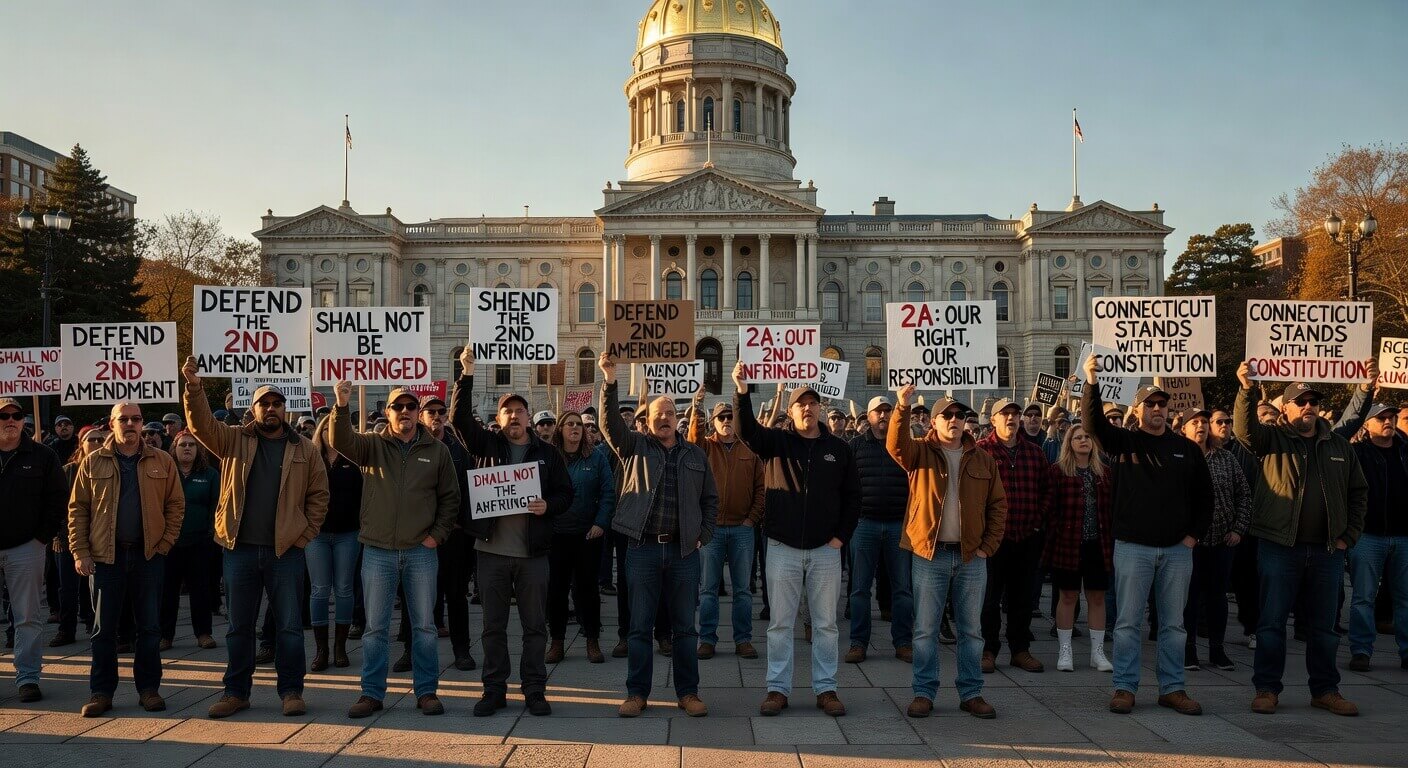
    Crowd of Second Amendment supporters gathered outside the Connecticut State Capitol building holding signs defending the right to bear arms

    Vague Standards, Guaranteed Lawsuits

    The phrase “reasonable controls” sounds harmless until you realize it’s a blank check for activist judges and greedy plaintiffs’ attorneys. What exactly counts as reasonable? Enhanced background checks? Real-time monitoring of every customer? Refusing sales based on hunches? The bill leaves that door wide open, inviting lawsuits whenever a firearm ends up in the wrong hands—even if the dealer followed every existing federal and state law at the time of sale.

    Pro-2A advocates have seen this playbook before. Similar liability schemes in other states have led to settlement shakedowns rather than actual reductions in crime. Criminals don’t buy guns from FFL dealers with paperwork; they steal them or use straw purchasers who already break the law. Punishing the legal industry does nothing to disarm gang members in Hartford or New Haven.

    Federal Protection Undermined

    The federal Protection of Lawful Commerce in Arms Act was specifically designed to shield legitimate firearm businesses from exactly this kind of predatory litigation. Connecticut’s new law tries to dance around PLCAA by creating a state-level cause of action. Expect immediate legal challenges arguing preemption, and pro-Second Amendment groups are already gearing up to fight it in court.

    In the meantime, dealers face a chilling effect. Many will likely adopt overly cautious policies, turning away legitimate customers who might trigger some vague “red flag” in a computer system. That’s not responsible business—it’s self-preservation in a hostile regulatory environment.

    What This Really Means for Gun Owners

    Connecticut residents who value their constitutional rights just got another reminder that their state government views the Second Amendment as a problem to be managed rather than a right to be protected. Every new layer of liability increases costs that get passed down to the end user. Training classes, range time, and even basic self-defense firearms become less accessible.

    The real solution to gun violence has never been more restrictions on the law-abiding. It’s consistent prosecution of violent offenders, secure borders, and addressing the cultural breakdown that produces criminals in the first place. HB 7042 does none of that. It simply transfers wealth from gun companies and dealers into the pockets of trial lawyers while eroding constitutional protections.

    Stay vigilant, Connecticut. The fight for our rights doesn’t end at the statehouse steps—it just moves to the next battlefield.

    Join the Fight - Second Amendment Foundation

    References

  • Multiple States Enact New Restrictions on 3D-Printed and Ghost Guns in 2026

    Multiple States Enact New Restrictions on 3D-Printed and Ghost Guns in 2026

    The recent wave of legislation targeting 3D-printed firearms and unserialized “ghost guns” in states like Colorado, Maine, New Jersey, New York, Virginia, and Washington represents yet another coordinated effort to chip away at our fundamental Second Amendment rights. These measures, sold under the guise of public safety, primarily burden law-abiding citizens who simply want to exercise their constitutional freedoms without excessive government oversight or tracking.

    Lawmakers claim these restrictions address rising recoveries of such firearms by police, yet the data often tells a different story. Many of these recoveries involve individuals already prohibited from owning guns, proving once again that criminals ignore laws while responsible gun owners face new hurdles. Serialization requirements and bans on certain manufacturing methods do nothing to stop determined bad actors—they only create a paper trail that could one day be used against everyday Americans.


    Proponents of these laws ignore the reality that homemade firearms have long been a part of American tradition, allowing individuals to build and maintain weapons without relying on commercial manufacturers subject to federal registries. Tightening rules on 3D printing and unserialized builds effectively limits innovation and self-reliance in the firearms community.

    Instead of focusing on enforcement against violent offenders, these states are expanding definitions of what constitutes a regulated firearm, potentially sweeping in common parts kits and printing files. This approach echoes past failed policies that expanded background checks and restrictions without measurable drops in crime rates.

    Gun owners across the country should view this trend as a call to action. Contact your state representatives, support organizations defending the right to keep and bear arms, and stay informed on how to legally navigate these changing rules. The right to bear arms includes the means to produce and maintain them—don’t let incremental restrictions erode that principle.

    Join the Fight - Second Amendment Foundation

    References

  • Senators Booker and Kim Reintroduce Federal Firearm Licensing Act Mandating Training and Renewals

    Senators Booker and Kim Reintroduce Federal Firearm Licensing Act Mandating Training and Renewals

    The latest push from New Jersey’s Democratic senators represents yet another blatant attempt to chip away at the Second Amendment under the guise of “public safety.” By reintroducing the Federal Firearm Licensing Act, they’re proposing a nationwide permission slip system that would force every law-abiding American to jump through federal hoops just to exercise a constitutional right. This isn’t about stopping criminals—it’s about creating a registry and control mechanism that burdens responsible gun owners while doing little to address actual violence.

    What’s Really in This Bill

    The legislation would require a federal license for any firearm purchase, complete with mandatory safety training that mixes written tests and live-fire components. Applicants would face expanded FBI background checks, and the license would need renewal every five years. Provisions allow for revocation if authorities decide someone “poses a risk,” a vague standard ripe for abuse. Proponents point to state examples, but those programs have consistently failed to deliver measurable drops in crime while driving up costs and wait times for honest citizens.

    Why This Approach Misses the Mark

    Real-world evidence shows that licensing schemes don’t disarm gang members or career criminals who already ignore laws. Instead, they create barriers for first-time buyers, single mothers in high-crime areas, and rural residents who rely on firearms for protection and hunting. Training mandates sound reasonable on paper, yet they ignore the millions of Americans who already pursue voluntary education through the NRA, USCCA, and local ranges—often at their own expense and initiative. Federalizing this process adds layers of bureaucracy without improving outcomes.

    History teaches us that gun control focused on owners rather than offenders simply shifts the burden onto the compliant. States with strict licensing haven’t outperformed constitutional carry states in violent crime reduction when you account for demographics and enforcement priorities. The focus should remain on prosecuting those who misuse firearms and addressing mental health failures, not erecting a national licensing infrastructure that could expand over time.

    Protecting Our Rights Moving Forward

    Americans who value the Second Amendment need to stay engaged. Contact your representatives, support organizations fighting these measures in court, and continue building skills through private training. The right to keep and bear arms isn’t a privilege granted by politicians in Washington—it’s a fundamental safeguard that licensing schemes seek to regulate into irrelevance. Responsible ownership thrives on personal responsibility, not federal permission slips renewed every five years.

    Join the Fight - Second Amendment Foundation

    References

  • UK Implements 3% Increase in Firearms Licensing Fees Effective June 2026

    UK Implements 3% Increase in Firearms Licensing Fees Effective June 2026

    In a move that further tightens the screws on Britain’s already heavily restricted firearms community, the UK Home Office has quietly rolled out a 3% hike in licensing fees effective June 4, 2026. Under the Firearms (Variation of Fees) Order 2026, costs for grants, renewals, and variations of firearms certificates, shotgun certificates, and related permits are climbing across the board. For responsible British shooters who already navigate one of the world’s most bureaucratic gun control regimes, this is yet another financial barrier designed to discourage lawful ownership.

    Small Increase, Big Message

    Three percent might sound modest on paper, but it lands on top of existing high fees that can run hundreds of pounds for a single certificate. Renewals that were already expensive just got pricier, and the change applies to any application processed on or after the June date. Law-abiding citizens who use firearms for sport, pest control, or collection now face an extra layer of cost simply for complying with the rules.

    Official UK firearms and shotgun certificates spread across a wooden table with application forms and payment receipts

    Another Brick in the Wall

    This fee increase fits a familiar pattern. Governments that restrict access to firearms rarely stop at outright bans. They layer on regulations, waiting periods, inspections, and now steadily rising costs that disproportionately affect working people and hobbyists. In the UK, where private ownership is already treated more like a privilege than a right, these incremental changes serve as a slow squeeze rather than a single dramatic policy shift.

    Compare that approach to the American model, where the Second Amendment stands as a clear barrier against exactly this kind of creeping disarmament through bureaucracy and expense. Every new fee or restriction in places like Britain serves as a reminder of why strong constitutional protections matter. Without them, even modest-sounding updates become tools to make legal ownership less practical over time.

    What This Means for Shooters

    British certificate holders planning renewals before June 2026 may want to act quickly to lock in current rates. Those considering new applications or variations should factor the higher costs into their budgets. More broadly, the change underscores the importance of staying organized, tracking deadlines, and pushing back against policies that treat lawful gun owners as revenue sources rather than citizens exercising a legitimate activity.

    Fee hikes like this rarely improve public safety. They simply make it costlier to follow the law. For American gun owners watching from across the pond, the lesson is straightforward: rights that are not vigorously defended can be regulated, taxed, and eventually eroded one small percentage point at a time.

    Join the Fight - Second Amendment Foundation

    References

  • UN Convenes Fifth Constructive Dialogue on Firearms to Address Global Trafficking in 2026

    UN Convenes Fifth Constructive Dialogue on Firearms to Address Global Trafficking in 2026

    The United Nations is once again flexing its globalist muscles with the fifth Constructive Dialogue on Firearms, set for May 13, 2026. Hosted by the UN Office on Drugs and Crime, this gathering of governments, NGOs, and so-called experts claims to target illicit trafficking under the UNTOC framework. In reality, it smells like another coordinated push to erode the rights of law-abiding gun owners everywhere while ignoring the real drivers of violence: corrupt regimes, porous borders, and criminal networks that laugh at international paperwork.

    American gun owners know this script all too well. Every few years the UN rolls out fresh “dialogues” and protocols that ultimately circle back to restricting civilian access to firearms. They frame it as fighting “trafficking,” yet the data shows most illegal guns in high-crime areas come from local thefts, straw purchases, or outright government failures—not from some shadowy international pipeline that more treaties will magically fix.

    Why This Matters for U.S. Gun Rights

    Our Second Amendment isn’t up for negotiation in a New York conference room. The United States already leads the world in responsible firearm ownership, with millions of law-abiding citizens using guns for self-defense, sport, and heritage. International bodies have no jurisdiction here, and any attempt to import foreign standards through backdoor diplomacy should be rejected outright by Congress and the states.

    Instead of obsessing over legal gun owners, these dialogues would do more good focusing on actual enforcement: securing borders, prosecuting traffickers, and holding failed states accountable for arming cartels. But that would require real solutions rather than feel-good global meetings that produce more bureaucracy and less freedom.

    Staying Vigilant in 2026 and Beyond

    Gun owners across America should watch this May event closely. Track which U.S. officials attend, what concessions get floated, and how domestic anti-gun groups try to spin the outcomes into new pressure campaigns. The best defense remains an informed, active, and armed citizenry that refuses to let unelected international forums dictate our constitutional protections.

    At the end of the day, firearms in the hands of free people deter tyranny far better than any UN resolution ever will. Keep your rifles clean, your magazines loaded, and your representatives accountable—this fight isn’t over just because another meeting is on the calendar.

    Join the Fight - Second Amendment Foundation

    References

  • New Jersey AG Sends Subpoenas to Firearms Dealers Seeking Customer Records

    New Jersey AG Sends Subpoenas to Firearms Dealers Seeking Customer Records

    In a move that has ignited outrage among Second Amendment advocates nationwide, New Jersey’s Attorney General has unleashed subpoenas on licensed firearms dealers throughout the state, demanding sweeping access to customer purchase records. This isn’t about public safety—it’s a calculated power grab aimed at chilling the rights of law-abiding citizens who simply exercise their constitutional freedoms.

    Why This Matters for Gun Owners

    These subpoenas target sensitive details like buyer identities, transaction histories, and even the types of firearms purchased. Dealers are being forced to hand over information that could easily be weaponized for future restrictions or registries. Pro-2A voices are quick to point out that such tactics bypass legislative processes and trample on privacy expectations that every American gun owner holds dear.

    Privacy Rights Under Attack

    Imagine your legal firearm purchase suddenly becoming public record fodder for bureaucrats with anti-gun agendas. This subpoena blitz raises serious questions about due process and Fourth Amendment protections against unreasonable searches. Gun owners in the Garden State and beyond are rightly concerned that this could set a dangerous precedent for other states looking to expand surveillance on the firearms community.

    Second Amendment Implications

    At its core, this legal standoff highlights how progressive-led states continue to erode the right to keep and bear arms through indirect means. Instead of outright bans, they’re using administrative pressure to create de facto gun owner databases. The backlash from dealers, advocacy groups, and everyday citizens underscores a growing resolve to fight back in court and at the ballot box. Lawful gun ownership isn’t a privilege—it’s a fundamental right that deserves robust defense against such encroachments.

    What Comes Next

    Legal challenges are already mounting, with pro-2A organizations vowing to hold the AG accountable. Gun owners should stay informed, support dealer compliance efforts where possible, and push for stronger state-level protections against record overreach. This episode serves as a stark reminder that eternal vigilance remains the price of liberty in today’s political climate.

    Join the Fight - Second Amendment Foundation

    References

  • Minnesota Senate Considers Trio of Bills That Could Reshape Hunting Access and Statewide Gun Law Uniformity

    Minnesota Senate Considers Trio of Bills That Could Reshape Hunting Access and Statewide Gun Law Uniformity

    Minnesota’s outdoor enthusiasts and Second Amendment supporters are sounding the alarm as the state Senate weighs a dangerous trio of bills that threaten time-honored hunting traditions and uniform gun laws across the Land of 10,000 Lakes. At a moment when sportsmen should be focused on preseason prep and mentoring new hunters, lawmakers are instead pushing measures that could criminalize everyday gear and fragment protections for lawful firearm owners.

    Group of Minnesota hunters in camouflage gear walking through a dense northern pine forest with rifles slung over shoulders during early morning light

    Consider SF 3655 first. This proposal would suddenly reclassify common semi-automatic hunting rifles and their standard-capacity magazines as illegal contraband. For generations, Minnesota hunters have relied on these reliable tools for deer, turkey, and predator control in the state’s vast public lands. Turning them into contraband overnight would amount to a de facto ban on many traditional practices, forcing law-abiding citizens to either surrender property they’ve owned legally for years or face serious legal consequences. Sportsmen’s groups across the state are rightly calling this an attack on rural heritage rather than any genuine public-safety measure.

    Next comes SF 3549, which aims to repeal Minnesota’s longstanding firearms preemption statute. That law has kept gun regulations consistent statewide, preventing a confusing and uneven patchwork of city and county rules that would make travel and recreation needlessly complicated. Without it, a hunter could find himself legal in one county and a criminal in the next. This repeal would erode the very uniformity that keeps Second Amendment rights practical for everyone from Duluth to Rochester.

    The third bill, SF 2320, would hand local governments broad power to restrict firearms and ammunition on public lands. Think about what that means for access to state forests, wildlife management areas, and trails that families have used for decades. Lawful carry and hunting could be banned or severely limited by the stroke of a city council pen, effectively shrinking the public spaces available for outdoor recreation and self-defense.

    These proposals represent a sharp departure from Minnesota’s balanced approach to gun rights and conservation. Rather than working with hunters who serve as the backbone of wildlife management through license fees and habitat work, the bills appear designed to chip away at access and ownership under the guise of local control. Opposition is growing fast among groups that represent tens of thousands of sportsmen who value both their heritage and their constitutional protections.

    If these measures advance, the ripple effects would reach far beyond the Capitol. New hunters might be discouraged, family traditions could fade, and the state’s reputation as a welcoming destination for outdoor sports would suffer. Now is the time for Second Amendment advocates to reach out to their senators, attend committee hearings, and remind lawmakers that protecting hunting access and uniform laws strengthens communities rather than endangering them. Minnesota’s outdoor legacy depends on it.

    Join the Fight - Second Amendment Foundation

    References

  • Muskets Like Those From 1776 Are Mostly Exempt From Today’s Gun Laws

    Muskets Like Those From 1776 Are Mostly Exempt From Today’s Gun Laws

    Picture this: You’re standing on the green at Lexington and Concord, gripping a smoothbore musket just like the Minutemen who stared down the Redcoats in 1775. No NICS background check, no waiting period, no serial number engraving. In fact, under current U.S. law, even a convicted felon could legally own that very same firearm in most states. Sounds like a Second Amendment dream, right? Well, it’s not a fantasy—it’s reality, thanks to a “loophole” in the Gun Control Act of 1968 that’s got the media buzzing.

    Close-up of a reproduction flintlock musket similar to those used by American revolutionaries in 1776, with polished walnut stock and brass fittings.
    Close-up of a reproduction flintlock musket similar to those used by American revolutionaries in 1776, with polished walnut stock and brass fittings. (via wtop.com)

    A recent Associated Press investigation blew the lid off this story, revealing how reproduction muskets and antique firearms—echoing the arms of our Founding Fathers—are largely exempt from today’s draconian gun regulations. The key? The GCA’s definition of an “antique firearm.” Anything manufactured before 1899 qualifies, as do exact replicas that can’t chamber modern fixed ammunition. We’re talking black powder muzzleloaders like the British Brown Bess or the French Charleville, the workhorses of the Revolutionary War.

    These aren’t dusty museum pieces gathering cobwebs. Modern reproductions from companies like Pedersoli, Lyman, or Dixie Gun Works are beautifully crafted, functional, and ready to fire. Load ’em with loose black powder, a patch-wrapped ball, and a flint or percussion cap, and you’re sending lead downrange at velocities that would make any redcoat think twice. No ATF Form 4473 required. No federal prohibitions. And in most jurisdictions, your felony rap sheet? Irrelevant.

    The Law That Proves Gun Rights Are Timeless

    Congress drew the 1899 cutoff line because that’s when smokeless powder and metallic cartridges revolutionized firearms. Pre-1899 designs? They’re relics, stuck in the past—incapable of accepting today’s high-powered ammo. This exemption isn’t some accident; it’s a nod to history. The Second Amendment wasn’t penned for Glocks or AR-15s—it protected the muskets, fowling pieces, and rifles of 1791. Fast-forward to today, and this rule stands as a bulwark against the gun-grabbers who want to redefine “arms” to exclude anything scarier than a slingshot.

    Take convicted felons, for instance. Modern gun laws strip them of their rights post-incarceration, treating every pistol or rifle as a perpetual threat. But hand a felon a flintlock? Legal in federal eyes, and often state too. Why? Because lawmakers recognize these aren’t the tools of urban crime waves. They’re symbols of liberty, hunting companions, and historical reenactment staples. The AP story highlights cases where ex-cons own these pieces outright, no restrictions. If that’s not proof that blanket bans are nonsense, what is?

    Why This Matters in the 2A Fight

    Gun control advocates love cherry-picking stats on “assault weapons” while ignoring that criminals don’t follow laws anyway. This antique exemption exposes the hypocrisy: If muskets were good enough for Patrick Henry (“Give me liberty or give me death!”), they’re good enough for self-defense today. Sure, they’re single-shot and slow to reload, but in a grid-down scenario or home defense pinch, they’re better than harsh language.

    Moreover, it fuels the push for broader reforms. Why regulate modern sporting rifles into oblivion when historical arms roam free? Groups like the NRA and GOA are already citing this in court battles, arguing that the right to keep and bear arms isn’t era-specific. Reproduction makers are thriving, too—sales spiked amid ammo shortages, proving Americans crave real firearms without the red tape.

    Of course, the hoplophobes are crying “loophole!” But to us 2A patriots, it’s a victory. It reminds Washington that you can’t regulate away the right to self-preservation. So next time you’re at the range, consider picking up a muzzleloader. Load it, lock it, and rock it—legally, historically, and unapologetically.

    Stay armed, stay free. What’s your favorite historical repro? Drop it in the comments.

    Join the Fight - Second Amendment Foundation

    References

  • Virginia’s New Semi-Automatic Firearms Sales Ban Set for July 1, 2026, Ignites Fresh Legal Battles

    Virginia’s New Semi-Automatic Firearms Sales Ban Set for July 1, 2026, Ignites Fresh Legal Battles

    Virginia gun owners are staring down the barrel of yet another government overreach as a new law banning the future sale, manufacture, and transfer of many semi-automatic firearms and magazines holding more than 15 rounds takes effect July 1, 2026. Marketed as a public-safety measure, the legislation does nothing to address criminals who already ignore existing laws while stripping law-abiding citizens of their constitutional rights.

    Crowd of Second Amendment supporters gathered outside the Virginia State Capitol building holding signs

    The measure has already triggered multiple lawsuits from the NRA and other gun-rights groups, arguing clear violations of the Second Amendment. These challenges highlight how the ban targets common, popular firearms used for self-defense, sport shooting, and hunting—exactly the kind of arms the Founders sought to protect. Courts will now decide whether Virginia can simply erase a century of legal precedent with the stroke of a pen.

    Why This Ban Misses the Mark

    Proponents claim the law will reduce mass shootings, yet history shows that determined criminals simply obtain firearms through illegal channels or use whatever tools remain available. Meanwhile, responsible Virginians who purchased their firearms legally now face arbitrary restrictions on future transfers, effectively freezing the market and punishing the very people who follow the rules. This is classic infringement dressed up as compromise.

    Division among owners is real, but the core truth unites most: once government decides which semi-autos are acceptable today, nothing stops them from expanding the list tomorrow. Magazine capacity limits have already proven ineffective in states that tried them first, with no measurable drop in violent crime rates.

    Next Steps for Virginia Gun Owners

    The lawsuits represent the first line of defense, but sustained grassroots pressure remains essential. Contact your legislators, support the organizations fighting these cases in court, and make your voice heard at the ballot box. Virginia has a proud tradition of resisting tyranny—now is the time to uphold it.

    Stay informed, stay armed, and never let politicians redefine what “shall not be infringed” actually means.

    Join the Fight - Second Amendment Foundation

    References

  • Blue State Faces Legal Setback in Defending Ammo Purchase Restrictions

    Blue State Faces Legal Setback in Defending Ammo Purchase Restrictions

    In a surprising turn of events during a recent federal court hearing, a prominent blue state found its defense of draconian ammunition restrictions crumbling under scrutiny. Lawmakers had pushed hard for mandatory serialization of every round and strict purchase caps, claiming these measures would curb crime. Instead, the proceedings exposed shaky legal footing that could pave the way for a stronger Second Amendment victory.

    Federal courtroom scene with judge reviewing ammunition restriction arguments during a key hearing

    Cracks in the State’s Case

    Attorneys for the state struggled to justify how tracking every bullet or limiting how many rounds law-abiding citizens can buy aligns with the Constitution. The court pressed hard on whether these rules even serve a compelling interest without violating the right to keep and bear arms. Judges noted that similar restrictions have already faced pushback in other jurisdictions, especially after landmark rulings emphasizing historical traditions over modern policy preferences.

    Why Serialization and Limits Miss the Mark

    Ammunition serialization sounds high-tech on paper, but it burdens manufacturers, retailers, and shooters alike with unnecessary costs and red tape. Purchase limits do even less to stop criminals, who ignore laws anyway, while creating headaches for sportsmen, competitors, and families protecting their homes. Responsible gun owners see these rules for what they are: incremental steps toward disarming the public under the guise of safety.

    Second Amendment Momentum Builds

    This hearing signals that courts are increasingly unwilling to rubber-stamp anti-gun policies without real evidence. As litigation continues, expect more challenges to pop up across the country. Gun owners remain vigilant, knowing that every legal setback for overreaching states strengthens the foundation of our fundamental rights. The fight isn’t over, but moments like these prove the Constitution still has teeth when defended vigorously.

    Join the Fight - Second Amendment Foundation

    References